

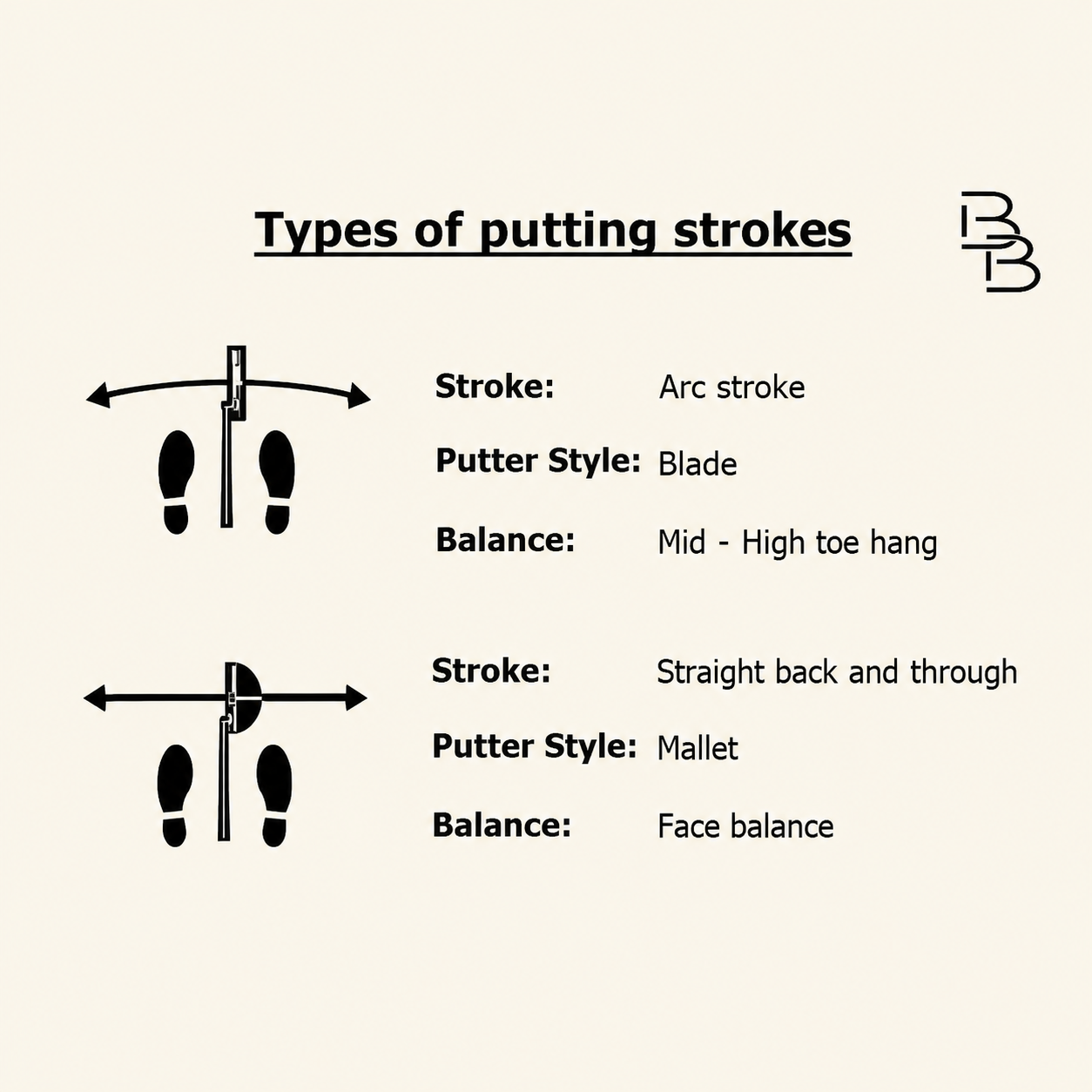
Arc or Straight putting stroke?
Understanding your stroke — and how it should shape your putter
Published by Tom Boucher · 2025
Ask most golfers to describe their putting stroke and they'll tell you it goes straight back and straight through. Put a camera behind them and the truth is usually different: the putter head moves on a gentle arc, opening slightly on the way back and closing through impact. That arc is natural, and for the vast majority of players it is a good thing.
Why golfers think their stroke is straight
- Perspective. Standing over the ball, your eyes are above and to the side of the putter head, which visually flattens the arc into what looks like a straight line.
- The 'more control' myth. Straight back and through sounds simpler and more repeatable, so players convince themselves that's what they're doing.
- Copying others. Strokes get borrowed from playing partners and from television without ever being checked against how the individual actually moves.
- Very little coaching. Full-swing mechanics get endless attention; putting mechanics rarely get looked at properly at all.
Why we build with toe hang
Because most golfers naturally putt with an arc, and because a blade-style head suits an arced stroke better than a face-balanced mallet, every Bertie Boucher putter is designed with roughly 45 degrees of toe hang. That lets the face rotate naturally through the stroke rather than fighting against it, which makes the timing of the release far more repeatable.

The right putter is personal
Beyond stroke type, a putter has to look right to you at address — the shape, the finish, the sightline, the contrast between head and insert. That combination of feel and look is different for every golfer, which is exactly why the configurator exists: thousands of combinations so you can build something that suits your stroke and your eye.